Research Sandpits & Networking Sprints
What are C-DICE research sandpits?
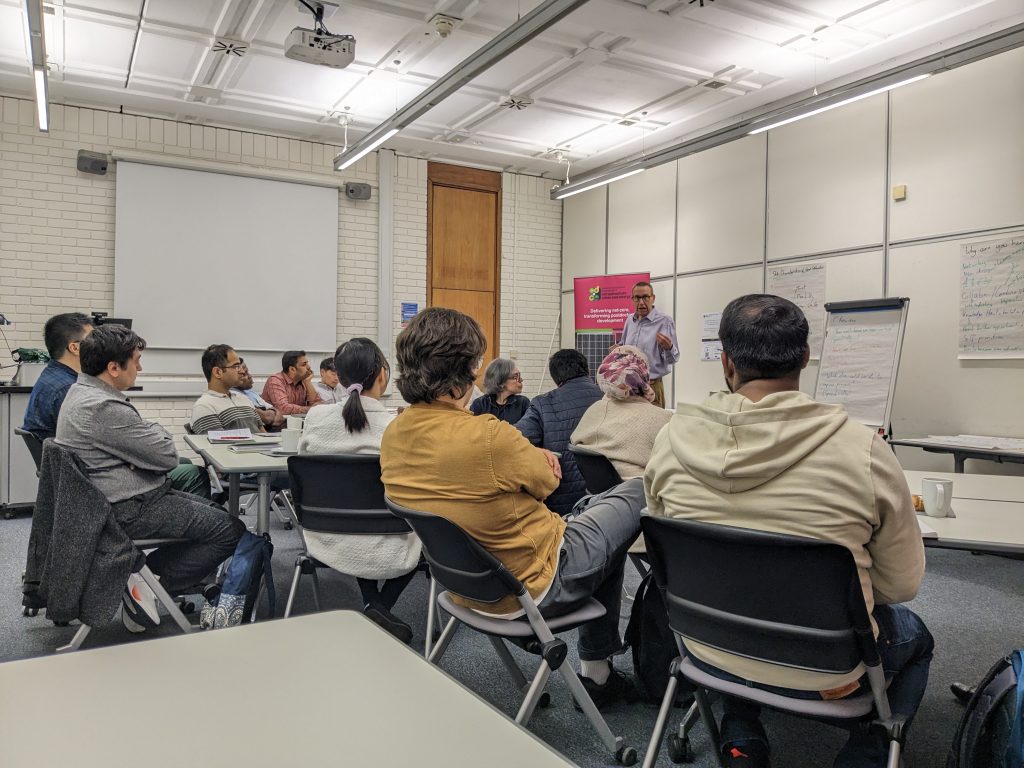
A C-DICE research sandpit is an interactive workshop, creating teams of postdoctoral researchers to develop a collaborative research proposal – with an opportunity to win up to £30k in funding.
A sandpit creates networks of exclusively postdoctoral researchers to generate collaborative research ideas that can be further developed via seedcorn funding. Awards of up to £30K are available for the best proposals developed during each sandpit. By participating, postdocs can learn how to create high quality research proposals as part of an interdisciplinary team.
It is an exciting new way of solving real-world problems and developing research ideas and solutions. The C-DICE sandpit also provides a unique opportunity for postdoctoral researchers to acquire multidisciplinary and cross-sector skills and expertise; learn how to shape a tractable and fundable research project; work collaboratively, and write and develop a funding proposal.
C-DICE have run 8 individual sandpits with themes to progress towards a net zero-carbon society around infrastructure, cities, and energy. If you want to know more about what happens during a sandpit, read our blog that explains the typical process!
Benefits to Postdocs
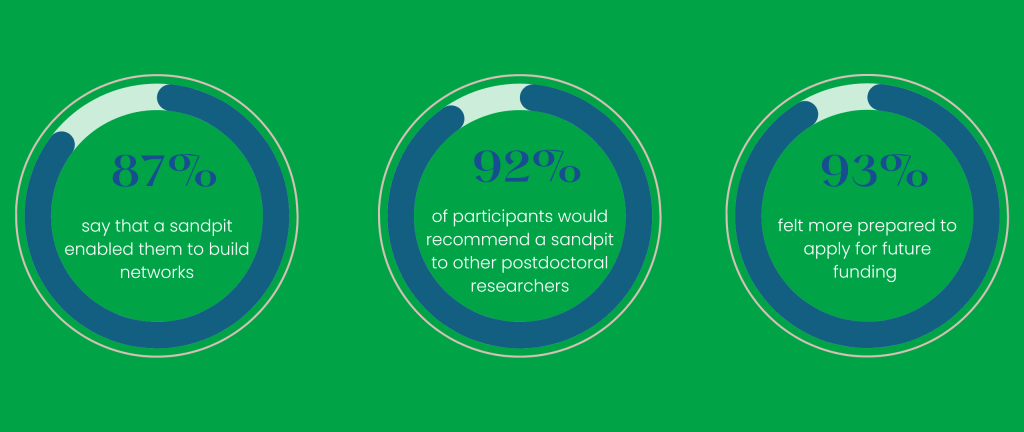
Sandpits are an opportunity for postdoctoral researchers to learn how to create high quality research proposals that will be able to receive further seedcorn funding. As C-DICE sandpits offer the opportunity to shape the research question for each sandpit, there is no requirement for the researcher to be an expert in the subject area of the sandpit topic. In addition to working with other postdoctoral researchers to develop a proposal, a sandpit also includes expert guidance and mentoring from C-DICE colleagues and industry partners.
The objectives of the C-DICE sandpit are to:
- Foster the development of novel solutions to problems related to the green-growth and net zero agendas.
- Develop interdisciplinary collaborations for post-doctoral researchers drawn from across a wide range of net zero related disciplines.
- Provide opportunities for participants to apply for seed-corn funding for high-quality research projects.
- Deliver a researcher development opportunity that can be evidenced with a “C-DICE Collaborative and Innovative Research Proposal Creation” micro-credential.
Past Research Sandpits
Sandpit 1: Promoting circular economy convergence
Summary of sandpit project: maximising progress towards net zero in cities and infrastructure industries while promoting convergence to a circular economy.
This sandpit focused on net zero solutions that are compatible with promoting circular economy convergence.
Winning Team:
- Will Ward
- Daniel Green
- Marianna Coulentianos
- Danielle Abbey
The Project

| Outputs Coulentianos MJ, Abbey D, So CT, Ward WOC. An Expert View on Data and Modelling for Planning Domestic Retrofit. Buildings. 2024; 14(4):887. https://doi.org/10.3390/buildings14040887 The paper looks at the challenges that practitioners in designing retrofit projects face from the perspective of data and modelling. We surveyed and interviewed key stakeholders working in different areas of domestic retrofit to get an expert view on the role that data and models have in current and future practice. We hope that the evidence obtained can be used to inform decision makers and provide opportunities for future study and engagement with wider stakeholders in domestic retrofit projects. |
Sandpit 2: Promoting user-driven adoption
Summary of sandpit project: unlocking user power and behaviour to promote and enable systematic transformation towards a net zero future.
This sandpit explored approaches to promoting user-driven adoption of net zero solutions or changes in user behaviour instrumental to achieving net zero targets.
Winning Team
- Matt Deakin
- Muhammad Saad Rafaq
- Shandelle Steadman
- Paraskevi Vatougiou
- Cheng Wen
The Project

Sandpit 3: Deploying the energy storage technologies
Summary of sandpit project: developing efficient and commercially viable short, medium and long term energy storage solutions that can be deployed widely and address the intermittency challenges of a fully integrated zero-carbon energy system.
This sandpit focused on critical issues related to developing and successfully deploying the energy storage technologies that are essential to enabling the transition to a zero-carbon energy system.
The Team
- Feiran Wang
- Xin Liu
- Fatih Gulec
- Shahrouz Nayebossadri
The Project

| Outputs Wang, H., Liu, X., Liu, X., Sun, C., & Wu, Y. (2023). Fluidisable mesoporous silica composites for thermochemical energy storage. Energy, 275, 127255. Fatih Güleç, William Oakley, Xin Liu, Shahrouz Nayebossadri, Feiran Wang, Edward H. Lester, “Chapter 9 – Status and progress of nanomaterials application in hydrogen storage” Book: Nanomaterials for hydrogen production and storage. The book is published by Taylor and Francis (https://www.routledge.com/Nanomaterials-for-Sustainable-Hydrogen-Production-and-Storage/Okolie- IEpelle-Mukherjee-Mahmoud/p/book/9781032442075). Dr Shahrouz Nayebossadri presented parts of this work at the Renewable Energy Conference (REN 2023), Paris, France, Oct. 2023 Presentation on aspects of sandpit project on Additive Manufacturing of Ti-V-Mn based Metal Hydrides for Enhanced Hydrogen Storage and Heat Transfer. 2024 MRS Spring Meeting & Exhibit, April 2024, Seattle, USA. |
Sandpit 4: Carbon reduction in built environment
Summary of sandpit project: considering options and solutions to help understand the systems and interactions in the built environment that help determine the optimal path for carbon reduction.
This sandpit investigated interactions between different built environment and infrastructure systems and the contexts influencing the optimal pathways to carbon reduction.
Winning Team
- Alex Elliot
- Maren Schnieder
- Niamh Fox
- Meng Le Zhang
- Michael Marshall
The Project

| Outputs This project has led to the creation of two working papers: (a) one outlining and contrasting developments and barriers in the domestic solar PV and heat pump landscapes, and (b) one focusing on Solar Together as a specific solar PV incentivisation scheme that could be adapted to encourage heat pump uptake. For both, publication as a working paper was selected to accelerate the dissemination of the findings of this project, with scope for development into peer-reviewed journal publication at a future date. Further motivation for this approach was that this format could more quickly be shared with key industrial stakeholder: paper (a) will be directly shared with Mott MacDonald and Nesta to provide further insight on the parallel sectors, and paper (b) will be shared with iChoosr (who run Solar Together) and MCS. Based on our communications and meetings, our findings provide iChoosr with evidence that strengthens their business case and allow schemes in new regions. The MCS will use our findings to demonstrate the efficacy of their new dashboard and inform future developments that could be made to improve its used in a research context (e.g. the MCS are considering new data releases partly in response to our feedback). |
Sandpit 5: Dispersed industrial decarbonisation
Summary of sandpit project: TASTES-techno-economic assessment of dispersed sites with thermal energy storage in the UK.
This sandpit examined the barriers and opportunities to electrification for dispersed industry, exploring alternatives to inform policy for a net zero future.
Winning Team
- Xin Liu
- Aleena Alex
- Fangming Yang
The Project

| Outputs Liu, X., Liu, X. (corresponding author), Yang, F. and Wu, Y., 2024. Experimental investigation of low-temperature fluidised bed thermochemical energy storage with salt-mesoporous silica composite materials. Applied Energy, 362, p.122953. 1st International Conference of Net Zero Carbon Built Environment, July 2024, Nottingham, UK. Collaborating with Prof. Wu at University of Nottingham, we will organise our workshop proposed in our proposal as a half-day session of this international conference. Presentation on aspects of sandpit project on Metal hydride-based solar energy storage system for building heat supply. Liu. X., Alex, A. and Yang, F. Assessment of dispersed sites with Thermal Energy Storage in the UK. The 1st International Conference of Net Zero Carbon Built Environment, Nottingham. 3rd-5th July 2024 Yang, F, Liu. X., Uguna, C., Wu, Y. Selective catalytic conversion of glycerol to methane over MOF-derived Ni/C catalyst. The 1st International Conference of Net Zero Carbon Built Environment, Nottingham. 3rd-5th July 2024 Liu. X. Assessment of dispersed sites with Thermal Energy Storage in the UK. The 1st International Conference of Net Zero Carbon Built Environment, Nottingham. 3rd-5th July 2024 (Invited talk) Liu, X. PI, University of Lincoln, College Research & Impact Fund, Developing next-generation salt composite materials for long-duration thermal energy storage. Total funding: £7,800 |
Sandpit 6: Hydrogen energy systems (Sponsored by HyDEX)
Summary of sandpit project: energy storage utilising battolyser-generated H2.
This sandpit explored the opportunities and barriers to progressing the role of hydrogen in energy systems.
Winning Team
- Elizabeth Ashton
- Humera Ansari
- Fatimah Abi Ghaida
The Project

| Outputs 13th INTERNATIONAL CONFERENCE ON RENEWABLE ENERGY RESEARCH AND APPLICATIONS (ICRERA) November 9 – November 13, 2024, Nagasaki, Japan Lizzie Ashton presented on “Economic Viability of a Battery-electrolyser System for Frequency Response and Hydrogen Production. the ICRERA Japan 2024 conference-https://ieeexplore.ieee.org/document/10815427 |
Sandpit 7: Towards net zero in the water industry
Summary of sandpit project: dye-Sensitized inorganic nanomaterials for organic contaminant removal from wastewater (DINOCReW).
The UK water and sewage industry faces many challenges enroute to achieving net zero while it must also simultaneously adapt to the substantial impacts of climate change on water and sewage service provision. Given these challenging circumstances and constraints, this sandpit aimed to develop the ideas and vision to develop solutions, both small and large, to support the water and sewage industry in becoming more sustainable and resilient, with positive outcomes for the environment.
Winning Team
- Stefan Warrington
- Lucrecia Alvarez Barrantes
- Robyn Worsley
- Donald Inns
- Irene Carra
The Project

| Outputs 17th International conference on materials chemistry (MC17) Nature-inspired xanthenoxanthene-4,10-dione a new building block for sustainable organic electronics Dr Stefan Warrington,a* Dr Joesph Cameron,b Dr Dylan Wilkinson,b Dr Mark Elsegood,a Dr Simon Teat,c Prof Jeff Kettle.a aLoughborough University (UK), bUniversity of Glasgow (UK), cAdvanced Light Source (USA). |
Sandpit 8: Small modular reactors in communities
Summary of sandpit project: SPARK – SMR perceptions advantages and risks knowledge.
This sandpit focused on identifying interconnected relationships, drawing on communities that can cocreate and transform areas benefiting from Small Modular Reactors – which are being developed to provide carbon-free energy to better manage energy demand and support the UK’s transition to net zero.
Winning Team
- Elizabeth Barsotti
- Swathi Mukundan
- Helen Osiolo
The Project

| Outputs Helen Osiolo (Loughborough University) & Swathi Mukundan (Loughborough University), Public Perceptions and Stakeholder Collaboration in Small Modular Reactor Siting: Insights from UK. 17th International Green Energy Conference (IGEC), Reykjavik, Iceland, October 12-15, 2025 |
What is a C-DICE networking sprint?
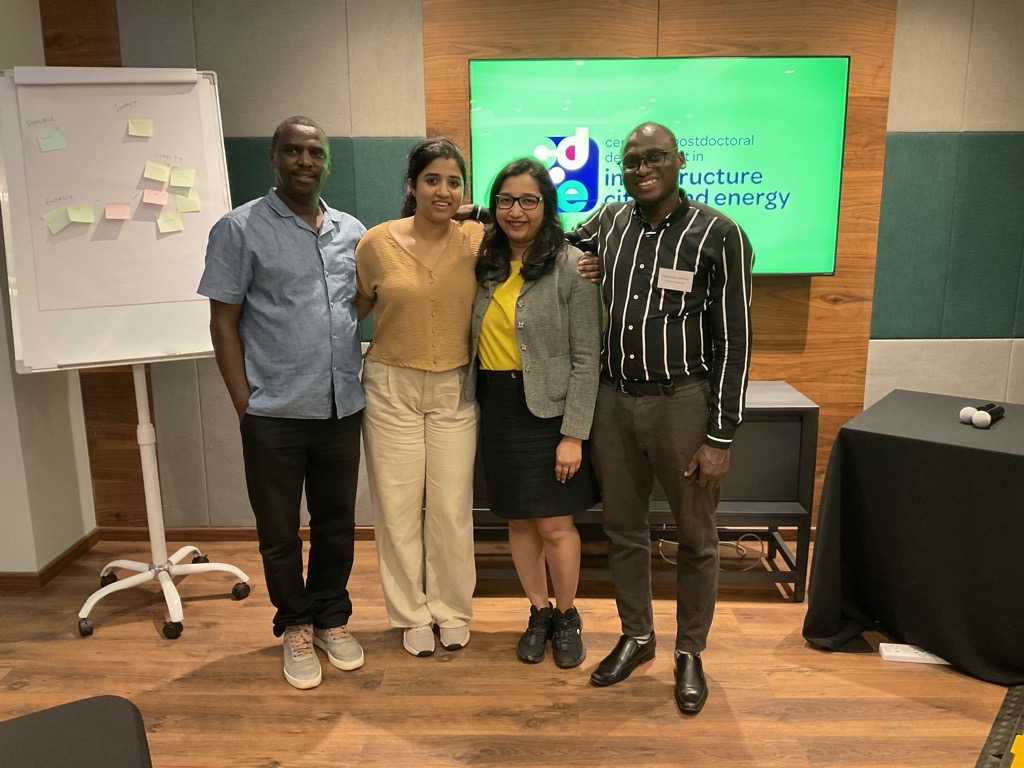
A networking sprint is an interactive workshop, creating teams of researchers to develop a collaborative network proposal with an opportunity to win up to £5k in funding.
A sprint is a short, focused event where people work together to solve problems and achieve specific goals. Unlike regular workshops or conferences, sprints emphasise teamwork and action over a couple of days, leading to meaningful results. For researchers, sprints are a great way to collaborate with others from different fields, develop innovative ideas, and build professional networks. C-DICE has created the networking sprint to help postdocs and early career researchers start to develop cross-disciplinary networks to build teams that can drive forward research ideas and proposals.
Benefits to Postdocs
- Enhance Collaboration Skills: Improved ability to build interdisciplinary networks.
- Understand Key Network Components: Insights into critical elements for successful research networks.
- Develop Research Network Ideas: Creation of innovative, actionable network proposals.
- Strengthen Budgeting Skills: Expertise in designing budget plans for network activities.
- Improve Pitching Abilities: Refined skills for presenting network proposals effectively.
- Excellence in Teamwork and Communication: Effective interdisciplinary teamwork and communication.
Past Networking Sprints
UK Sprint (10-11 February 2025) –
Develop a network to address the challenges of achieving net zero by 2035 from a regional perspective, identify specific challenges, and develop a plan for creating a network that will utilise a scenario-based systems approach to advance progress toward net zero.
Winning Team:
- Dr. Seif Allah El Mesloul Nasri
- Dr. Sahar Mirzaie
- Grace Elisha Mwesigwe
Network Title: NetZero Digital Twin Alliance | Driving Cross-Sector Collaboration for a Net-Zero Future
Nepal Sprint (5-6 March 2025) –
Develop a network for developing and using enhanced planning and modelling tools to incorporate eCooking, fuel stacking, and improved financial data.
Winning Team:
- Dr. Deblina Majumder
- Dr. Nawraj Bhattarai
- Dr. Lixu Liu
- Dr. Bassanta Raj Adhikari
- Ms Timila Bajracharya
Network Title: Partnership for Developing and Demonstrating a Cooking Model within the Ring-Road of Kathmandu, and bio gas utilisation in rural areas in Godaita.
Rwanda Sprint (20-21 March 2025) –
Develop a network in energy storage and the use of different types of energy storage for time-shifting energy use for cooking and other applications (e.g. charging during the day and being able to use at night) for regions with limited, intermittent or unreliable energy supplies.
Winning Team:
- Dr. Shivangi Sharma
- Dr. Swathi Mukundan
- Dr. Isaac Ntihinyuzwa
- Dr. Cyprien Nsengimana
Network Title: Self-Sustaining Community Networks for Clean Cooking in Off-Grid Rwanda: A Feasibility Study
India Sprint (23-24 September 2025) –
Develop a network to address some of the challenges of plastic waste.
Winning team:
- Dr. Mugdha Kshirsagar
- Mihyun Kim
- Sonal Waghmare
Network title: Circular Solutions for Plastic Waste in Pre and Post Construction of Buildings: Driving Net Zero Pathway. Read the blog here.